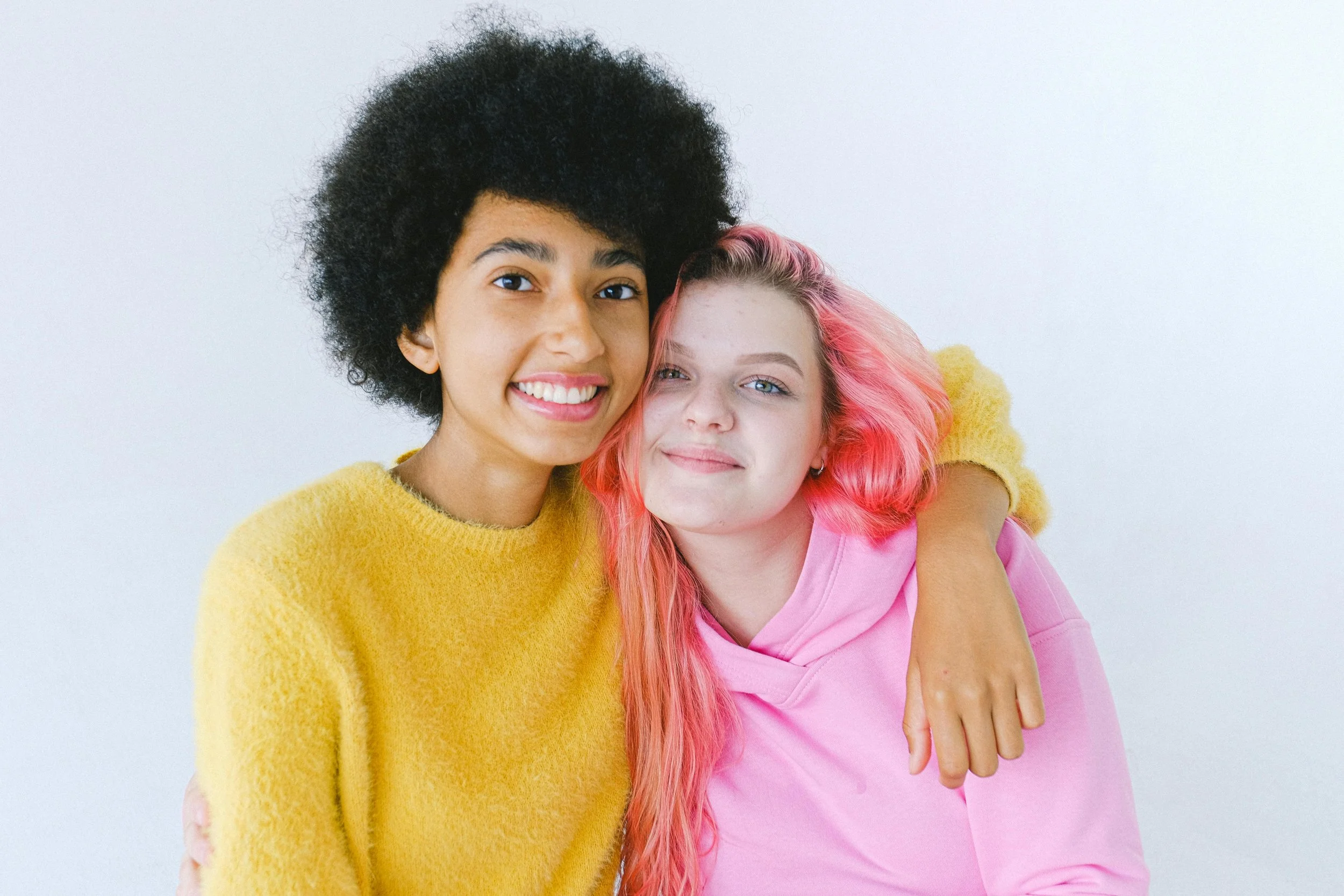
Why Belonging Matters More Than Confidence
Confidence is often seen as the goal for young people—but it actually grows from something deeper: belonging. This post explores why feeling safe, accepted, and able to be yourself is the true foundation for confidence, and how creating spaces of belonging allows youth to find their voice, identity, and leadership.
We hear it all the time:
“I just want my child to be confident.”
Confidence has become the goal. The marker of success. The thing we believe will help young people navigate the world, speak up, and stand strong in who they are.
But what if confidence isn’t the starting point?
What if it’s the result of something deeper?
Confidence Isn’t Built First
Confidence is often treated like something we can teach directly:
Speak up
Be brave
Believe in yourself
But for many young people, especially those still forming their identity, these messages can feel out of reach.
Because confidence doesn’t develop in isolation.
It develops in response to an environment.
And the most important condition in that environment is:
Belonging.
What Belonging Actually Means
Belonging is not just being included.
It is the feeling of:
Being accepted as you are
Not needing to change to fit in
Feeling safe to express yourself
Knowing you won’t be rejected for who you are
It is both emotional and psychological safety.
And for youth, especially those navigating identity, difference, or uncertainty, this matters more than anything else.
What Happens Without Belonging
When a young person does not feel like they belong, they don’t become confident.
They adapt.
They:
Shrink to fit expectations
Mask parts of themselves
Stay quiet to avoid judgment
Seek approval instead of trusting themselves
From the outside, this can look like:
Shyness
Disengagement
People-pleasing
“Lack of confidence”
But underneath, it’s not a confidence issue.
It’s a belonging issue.
What Happens When Belonging Comes First
When a young person feels like they belong, everything shifts.
They begin to:
Speak more freely
Take social and emotional risks
Try new things without fear of failure
Express opinions and ideas
Confidence emerges, not because it was forced, but because it was safe to develop.
This is why in environments where youth feel deeply accepted, you often see:
Stronger voices
Deeper connections
Higher engagement
More authentic leadership
Why This Matters Right Now
Today’s youth are navigating:
Social comparison
Identity exploration
Increased awareness of differences
Fear of being judged or excluded
In this environment, telling them to “just be confident” misses the mark.
Because what they are really asking is:
“Is it safe for me to be myself here?”
If the answer is no…or even unclear…confidence will not follow.
The Role of Adults and Spaces
Belonging is not something young people create alone.
It is something that is built around them.
Adults, mentors, and communities set the tone.
We create belonging when we:
Normalize differences instead of highlighting them
Avoid labeling or singling out identities
Model respect and openness
Create environments where no one has to “earn” their place
This is especially important in inclusive spaces.
Belonging does not require explanation.
It requires intentional culture.
Why This Matters for Magical Rebels
At Magical Rebels, belonging is not a side effect.
It is the foundation.
This is a space for those who identify with the girl experience and lead a feminine lifestyle—across identities, expressions, and backgrounds.
No one is asked to explain who they are.
No one is singled out.
No one has to prove they belong.
Because when belonging is established:
Voice follows.
Confidence grows.
Leadership emerges.
Final Thought
Confidence is not the first step.
Belonging is.
And when people feel like they are truly seen, accepted, and safe to be who they are, something powerful happens:
They don’t just become confident.
They become themselves.

The Missing Piece: Spirituality in the Lives of Youth and Young Adults
Today’s youth are more connected than ever—yet many feel a deep sense of disconnection from meaning, identity, and purpose. This post explores how spirituality, separate from religion, has become a missing piece in the lives of young people, and why creating space for reflection, inner connection, and personal belief is essential for their emotional well-being and self-discovery.
There is a growing conversation happening, sometimes quietly, sometimes in very visible ways, about what today’s youth are missing.
They are more connected than any generation before them. They have access to information, communities, and perspectives at an unprecedented scale. They are aware, engaged, and deeply thoughtful. And yet, many young people are also navigating heightened levels of anxiety, disconnection, and uncertainty about who they are and where they belong.
When you look beneath the surface, one pattern begins to emerge:
Spirituality is often the missing piece.
Not religion, necessarily. Not doctrine or rules. But spirituality in its most essential form is a sense of connection to self, to meaning, to something larger than the immediate moment.
What Do We Mean by Spirituality?
Spirituality, in this context, is not about telling young people what to believe.
It’s about giving them space to explore:
What feels meaningful to them
How they understand their place in the world
What values guide their choices
How they process experiences beyond logic alone
It is the difference between simply existing and feeling connected and grounded within your own life.
For many youth today, that framework is missing.
Why Is It Missing?
There are several contributing factors:
1. The decline of traditional structures
Many families are less connected to organized religion or community-based belief systems than in previous generations. While this has created freedom and flexibility, it has also removed a built-in space where deeper questions were once explored.
2. A hyper-digital world
Young people are immersed in fast-paced, high-stimulation environments. Social media, constant communication, and comparison culture leave little room for stillness, reflection, or internal awareness.
3. A focus on performance over presence
Achievement, productivity, and external validation are often prioritized over internal development. Youth are taught how to succeed—but not always how to understand themselves. This report from the Girl Scouts of Northeast Texas paints a sad picture of the state of girls.
4. Lack of language for inner experience
Many young people feel deeply but lack the framework or vocabulary to process those feelings in a meaningful way.
What Happens When Spirituality Is Missing?
When there is no space for reflection, meaning, or connection, young people often experience:
A sense of emptiness or lack of purpose
Difficulty forming a stable sense of identity
Increased anxiety or emotional overwhelm
A reliance on external validation to define self-worth
This is what some describe as a spiritual void, not because something is wrong with them, but because something essential hasn’t been nurtured.
What Are They Reaching For Instead?
When spirituality is absent, young people don’t stop searching they redirect the search.
You see this in:
The rise of alternative spiritual practices
Interest in astrology, manifestation, and ritual
Deep engagement with identity exploration
A desire for experiences that feel meaningful, not just entertaining
These are not random trends. They are signals.
They point to a generation asking: “Where do I find meaning? Where do I belong? Who am I, really?”
The Opportunity for Adults and Mentors
The goal is not to replace one system with another or to define belief for them.
The goal is to create space.
Space where young people can:
Reflect without judgment
Ask questions without needing immediate answers
Explore different perspectives respectfully
Develop their own sense of meaning and connection
This can look like:
Journaling or guided reflection
Conversations about values and identity
Time in nature and awareness of cycles
Simple rituals that create pause and intention
Modeling curiosity instead of certainty
Why This Matters for Magical Rebels
At Magical Rebels, spirituality is not about prescribing belief, it’s about reconnection.
Reconnection to:
Voice
Identity
Inner knowing
A sense of belonging that doesn’t require explanation
For those who identify with the girl experience and lead a feminine lifestyle, this work is especially important. Many have been taught to look outward for validation, to shrink, or to disconnect from their own intuition.
Spirituality, when approached in an open, inclusive way, helps restore that connection.
Final Thought
Young people are not lacking depth. They are not disinterested in meaning.
They are searching.
And when we recognize spirituality as a missing, but necessary, part of their development, we can begin to meet them differently.
Not by giving them all the answers.
But by helping them build the capacity to explore the questions that matter most.

The Spiritual Void and the Rise of Modern Witchcraft
As more young people seek meaning outside traditional belief systems, modern witchcraft has emerged as a powerful form of personal spirituality. This post explores the concept of the “spiritual void,” why it’s showing up for today’s youth, and how practices rooted in ritual, nature, and self-discovery are helping them reclaim agency, identity, and connection in a rapidly changing world.
Across generations, there are moments when people begin to feel a quiet but persistent absence—something missing beneath the routines, expectations, and structures of everyday life. This absence is often described as a spiritual void: a sense of disconnection from meaning, purpose, identity, or something larger than oneself.
For today’s youth especially, this feeling is becoming more visible.
They are growing up in a world that is highly connected digitally, yet often fragmented emotionally and spiritually. Traditional institutions, religious, cultural, and communal, no longer hold the same central role they once did for many families. At the same time, there is increased exposure to global perspectives, identities, and belief systems. The result is a generation that is both curious and untethered, seeking meaning, but not always finding it in conventional places.
This is where the conversation around modern witchcraft often emerges.
It’s important to understand that what is trending today under the label of “witchcraft” is not a single, uniform practice. For many, it is not about spells or supernatural power in the way media portrays it. Instead, it represents a broader movement toward personal spirituality, ritual, and self-defined belief systems.
So why is it resonating right now?
First, it offers agency.
In a world where many systems feel out of individual control, practices associated with witchcraft, journaling, intention-setting, working with cycles of the moon or seasons, give people a sense of participation in their own lives. It becomes less about being told what to believe and more about choosing what feels meaningful.
Second, it is deeply tied to nature and rhythm.
Many modern interpretations draw from seasonal cycles, earth-based traditions, and the idea that life moves in phases, growth, rest, release, renewal. For young people especially, this can feel grounding in contrast to the fast, constant pace of digital life. It reconnects them to something tangible and cyclical rather than linear and pressured.
Third, it creates space for identity exploration.
Spirituality, when approached outside rigid structures, allows individuals to ask: Who am I? What do I believe? What feels true to me? For youth navigating identity—whether gender, emotional, or social this openness can feel safer and more affirming than systems that prescribe answers.
Fourth, it fosters ritual and meaning-making.
Humans are wired for ritual. Even small, intentional acts- lighting a candle, setting a goal, reflecting on a phase of life can create a sense of significance and grounding. What some call “witchcraft” is often simply a structured way of creating those moments.
At the same time, it’s important to hold nuance, especially when guiding young people.
Not everything labeled as “witchcraft” online is rooted in understanding or respect for its origins. Some practices are borrowed, simplified, or commercialized in ways that disconnect them from their cultural or spiritual roots. This creates an opportunity for education: helping youth understand the difference between personal spiritual exploration and cultural appropriation or trend-driven behavior. We’ve done a deeper dive in our private youth coaching group about this because it is so important.
The goal is not to steer young people toward or away from any specific belief system.
The goal is to help them develop awareness.
To understand that:
People choose beliefs for different reasons: community, tradition, identity, healing, or meaning
Spirituality can take many forms, from structured religion to personal practice
It is okay to explore, question, and evolve
Respect for others’ beliefs and for the origins of practices is essential
In spaces like Magical Rebels, these conversations are not about defining what is “right.” They are about creating room for thoughtful exploration.
Because the presence of a spiritual void is not inherently negative.
It is often the beginning of a search.
And for many, what looks like a trend, like the rise of witchcraft, is actually a reflection of something deeper: a desire to reconnect, understand, and find meaning in a world that doesn’t always offer clear answers.
When we meet that curiosity with openness instead of fear, we give young people something far more powerful than answers.
We give them the tools to ask their own questions, and the confidence to explore what comes next.

When Adults Need to Know, But Kids Already Understand
Parents often feel the need to “prepare” their children for differences, but in many cases, kids already navigate diverse identities—like gender and LGBTQ+ experiences—with ease and acceptance. This blog explores how adult fears can unintentionally shape a child’s perspective, why privacy matters when it comes to identity, and how creating inclusive spaces allows young people to lead with empathy, confidence, and belonging.
There’s a moment that happens more often than we talk about.
An adult pauses, asks a question, or expresses concern, usually framed as a need to “be prepared.”
It sounds responsible.
Thoughtful, even.
But underneath that instinct is something worth examining: Who is this really for?
Because more often than not, the children are already fine.
In many youth spaces, especially those rooted in belonging and identity exploration, young people show us something remarkable. They meet one another as humans first. They build connection through shared experiences, humor, curiosity, and kindness, not labels. What adults may see as something that requires explanation, children often experience as simply… normal.
And yet, adults frequently feel the need to step in.
This is where we begin to see the subtle layering of adult fear onto a child’s experience.
The desire to “know ahead of time” is often rooted in uncertainty. Parents want to say the right thing. They want to guide well. They want to protect. These are valid instincts. But when that desire turns into a need to manage or pre-frame a situation that a child has already navigated with ease, it can unintentionally introduce confusion where none existed before.
A child who has accepted a peer without hesitation may suddenly be prompted to question that experience:
Is this something I should be thinking differently about? Is this something I should be concerned about?
In that moment, the adult hasn’t just informed—they’ve reframed.
There is also a deeper ethical layer that often goes unspoken.
When adults expect to be told about another child’s identity, particularly when it comes to something as personal as gender identity, they are, knowingly or not, asking for access to information that does not belong to them. A child’s identity is not a public announcement. It is not a detail to be distributed for the comfort of others. Sharing that information without consent is not preparation, it is a violation of privacy.
In spaces like Magical Rebels, this distinction matters deeply.
Magical Rebels exists for those who identify with the girl experience and lead a feminine lifestyle. That includes a wide spectrum of identities, expressions, and lived experiences. Our role is not to categorize or disclose those identities. Our role is to create an environment where they are respected, protected, and allowed to exist without explanation.
Because the truth is: inclusion does not require disclosure.← READ THAT AGAIN
We do not need to single out individuals to create a culture of belonging. In fact, doing so often undermines it. Instead, we set a clear foundation:
This is a space where all are respected.
This is a space where kindness is expected.
This is a space where you are safe to be who you are.
Children understand this far more intuitively than we give them credit for.
They do not need to be warned about difference. They need to be modeled respect.
They do not need to be prepared for inclusion. They need to experience it.
And perhaps the real work, for all of us, is not in preparing children for the world, but in unlearning the fear-based narratives we’ve been taught about it.
When we step back, when we trust, when we resist the urge to control or categorize, something powerful happens.
We make space.
Space for kids to lead with empathy.
Space for identity to exist without scrutiny.
Space for connection to form without conditions.
At Magical Rebels, that space is intentional.
Because every young person deserves the chance to show us what the world can look like when it isn’t filtered through fear—but built through belonging.